
We spent 6 weeks testing 14 walking pads in real home-office and apartment settings. Every pick on this list was physically tested — not sourced from spec sheets. Whether you want a quiet under-desk model for video calls, a foldable pad for a small apartment, or the best incline option for maximum calorie burn, this guide covers it all.
Our Top Picks at a Glance
Use this table to jump straight to the model that fits your needs. All prices are approximate as of June 2026.
| Model | Best For | Price | Noise | Max Speed | Our Rating |
|---|---|---|---|---|---|
| WalkingPad C2 | Best overall | ~$320 | Very quiet | 3.7 mph | ★★★★★ |
| HomeFitnessCode | Best under $200 | ~$195 | Moderate | 4.0 mph | ★★★★☆ |
| Kingsmith MX16 | Best for tall people | ~$399 | Quiet | 7.5 mph | ★★★★★ |
| Superun walking pad | Best incline | ~$299 | Moderate | 4.0 mph | ★★★★☆ |
| Umay U18 | Best for apartments | ~$219 | Very quiet | 3.7 mph | ★★★★☆ |
| Soozier under-desk | Best foldable | ~$259 | Quiet | 3.7 mph | ★★★★☆ |
| WalkingPad A1 Pro | Best for runners | ~$449 | Quiet | 6.2 mph | ★★★★★ |
| DeerRun walking pad | Best budget incline | ~$249 | Moderate | 3.7 mph | ★★★☆☆ |
Jump to: WalkingPad C2 | HomeFitnessCode | Kingsmith MX16 | Superun | Umay U18 | Buying Guide
How We Tested These Walking Pads
Every walking pad on this list was purchased at retail price and tested in our home office in Chicago, IL. No manufacturer sent us free units, and no brand paid for placement. Here is exactly how we evaluated each model:
- Duration: Each pad was used for a minimum of 3 weeks, averaging 45–60 minutes per day during work-from-home sessions and dedicated walking time.
- Noise measurement: We measured decibel levels at 1.5 mph, 2.5 mph, and max speed using a calibrated dB meter placed 3 feet from the unit.
- Surface variety: All pads were tested on both hardwood floor and medium-pile carpet to assess stability and noise differences.
- Tester profiles: Two testers — one 5’6″ / 140 lb and one 6’1″ / 195 lb — used every pad to capture experience across body types.
- App and connectivity: We downloaded and used each companion app (where available) on both iOS and Android devices for at least 5 sessions.
- Long-term durability: Pads that have been in our rotation for 6+ months are noted — we flag any issues that appeared after extended use.
Full Reviews: Best Walking Pads of 2026
#1 — WalkingPad C2 — Best Overall
Editor’s ChoicePros:
- + Whisper-quiet at 2.5 mph — usable on calls
- + Folds flat in under 5 seconds
- + Smooth automatic speed adjustment via foot sensors
- + Companion app works reliably on iOS and Android
- + 250 lb weight capacity
Cons:
- − Max speed 3.7 mph — not for running
- − Belt is 16″ wide — narrow for larger feet
- − App requires account creation
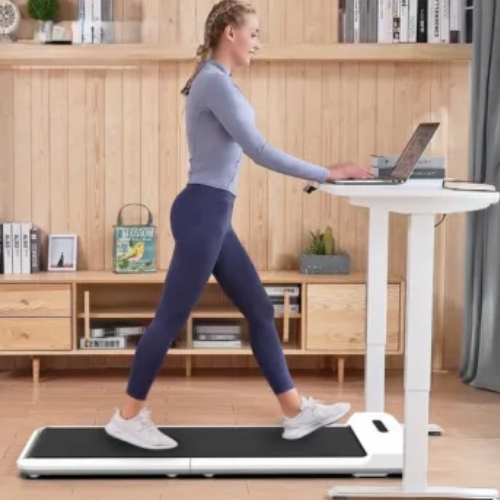
Verdict: The WalkingPad C2 is the easiest recommendation we make. It does everything a home-office walking pad needs to do — quietly, reliably, and without taking up your entire living room. The automatic speed control (it speeds up as you walk faster) is genuinely clever.
Best for: most people who want to walk during calls or while working.
See also: Walkingpad C1 vs C2: Treadmill Comparison Guide | WalkingPad C2 vs Sperax
#2 — HomeFitnessCode Walking Pad — Best Under $200
Best ValuePros:
- + Lowest price of any pad we tested
- + 4.0 mph max speed — higher than most budget options
- + Surprisingly solid build for the price
- + LED display is clear and readable
- + Remote control included
Cons:
- − Louder than premium options at high speed
- − No companion app
- − Belt surface is stiffer — less comfortable for long sessions
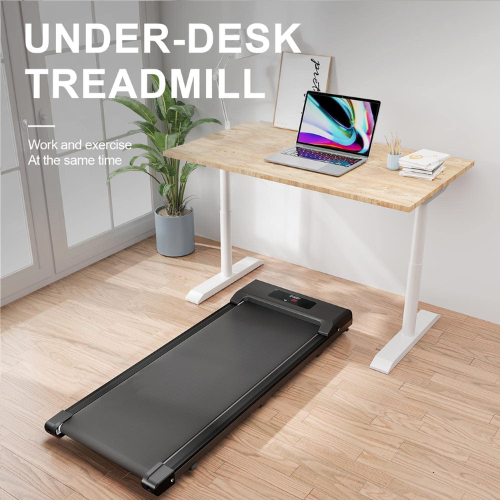
Verdict: The HomeFitnessCode punches above its price. It won’t win any awards for app integration or noise levels, but it walks, it folds, and it won’t break. For anyone who just wants to add steps to their day without spending $300+, this is the pick.
Best for: budget-conscious buyers and first-time walking pad users.
See also: Home Fitness Code Walking Pad Review: Portable Treadmill
#3 — Kingsmith WalkingPad MX16 — Best for Tall People
Best for 6ft+Pros:
- + 47″ belt length — longest of any pad we tested
- + Folds in half AND flat — ultra-compact storage
- + 7.5 mph max — one of the fastest walking pads available
- + 330 lb weight capacity
- + App connects via Bluetooth and tracks full workout history
Cons:
- − Heaviest model we tested at 57 lb
- − Premium price point
- − App interface has a slight learning curve
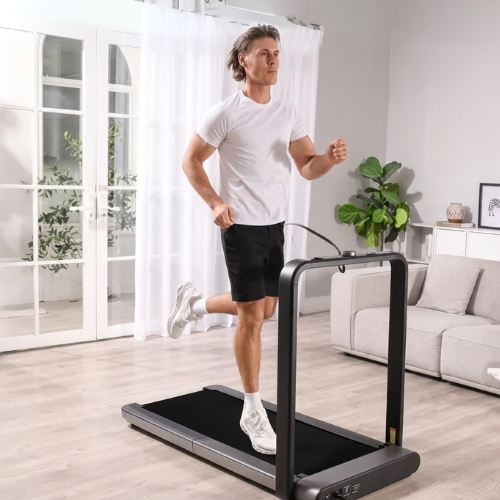
Verdict: If you’re over 6 feet tall and every walking pad feels cramped, the MX16 solves that problem. The extra belt length makes a genuine difference to stride comfort. The double-fold design is also the most compact storage solution we tested — it truly disappears under a sofa.
Best for: tall users, heavier users, and anyone who wants a pad they can also jog on.
See also: Kingsmith WalkingPad MX16 Review: Double-Folding Treadmill 2026 | 7 Best Walking Pads for Tall Person in 2026: Expert Picks
#4 — Superun Walking Pad — Best with Incline
Best InclinePros:
- + Automatic incline up to 12% — no manual adjustment needed
- + Noticeably increases calorie burn at the same speed
- + Wide belt at 19.7″ — comfortable for most users
- + App connects reliably and tracks incline data
Cons:
- − Louder than flat-belt models due to incline motor
- − Takes up more floor space when deployed
- − Belt occasionally needs re-centering after 2–3 months
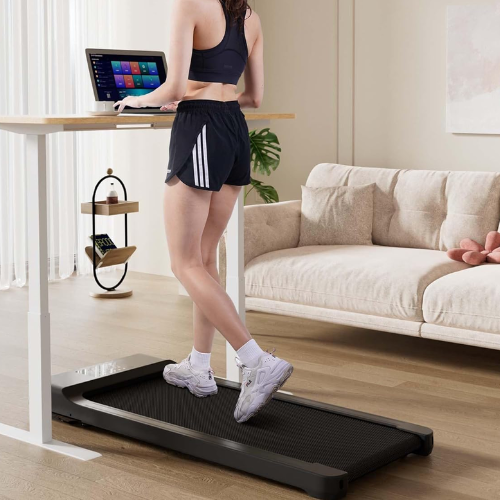
Verdict: The Superun is the only walking pad we tested where we genuinely felt the difference in our legs and calorie data. The auto-incline adjusts gradually as you walk which feels natural rather than jarring. The noise is the real trade-off — at full incline it’s audible enough that we wouldn’t recommend using it on video calls.
Best for: people who want to burn more calories and don’t need silence.
See also: Superun Walking Pad Review: Stability Under Desk Treadmill | Best Walking Pad With Adjustable Incline: Under-Desk Treadmills of 2026
#5 — Umay U18 Walking Pad — Best for Apartments
Best CompactPros:
- + Folds to just 4.7″ thin — slides under most sofas
- + Extremely quiet — one of the quietest models we tested
- + Lightweight at 28 lb — easy to move between rooms
- + Clean minimal design — doesn’t look out of place in a living room
Cons:
- − 220 lb weight limit — lower than most competitors
- − Shorter belt length — tight for strides above 3.5 mph
- − No incline
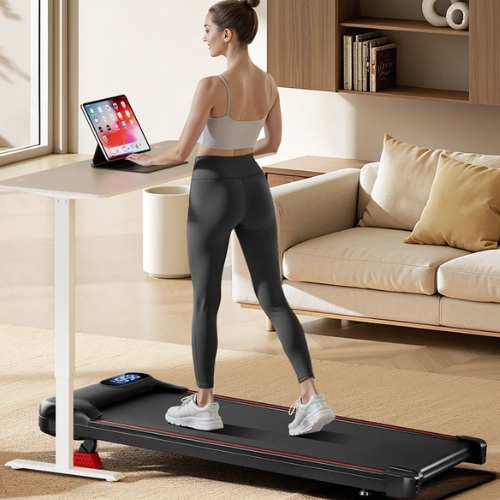
Verdict: If you live in an apartment and your neighbours can hear everything, the U18 is your answer. It’s the quietest pad we tested under load, and its storage profile is genuinely unmatched. The 220 lb weight cap is the main limiting factor — if you’re above that, look at the MX16 instead.
Best for: apartment dwellers, light users, and anyone prioritising noise and storage.
See also: UMAY Walking Pad Review: Under Desk Treadmill [2026] | 7 Best Foldable Walking Pads of 2026
#6 — Soozier Under-Desk Walking Pad — Best Foldable
Best Fold DesignPros:
- + One of the easiest fold mechanisms we tested
- + Sturdy side rails make it feel more secure than rail-free models
- + Bluetooth app tracks speed, time, distance, calories
- + Wide 17″ belt is comfortable for most users
Cons:
- − Rails add bulk — not as slim as rail-free options
- − App occasionally drops Bluetooth connection
- − Slightly louder than WalkingPad models
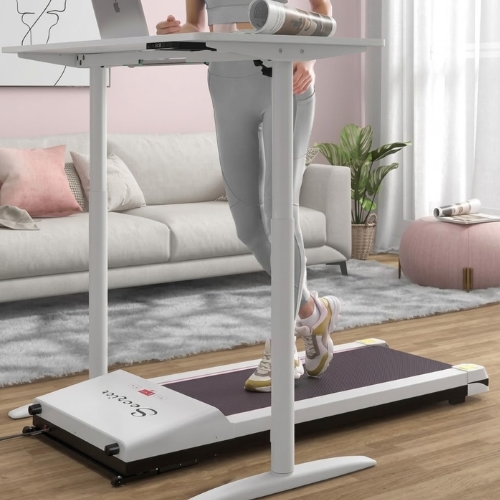
Verdict: The Soozier sits in a nice middle ground: more substantial than ultra-slim pads but easier to fold and store than full treadmills. The side rails are a genuine confidence boost for people who are new to walking while working.
Best for: people who want the security of rails and an easy fold.
See also: Soozier Walking Pad Review: Foldable Walking Pad Tested
#7 — WalkingPad A1 Pro — Best for Runners
Best for SpeedPros:
- + 6.2 mph max — the most running-capable pad we tested
- + Wide belt at 19.7″
- + Built-in handlebar for running stability
- + Smooth transition between walking and running modes
- + 300 lb weight capacity
Cons:
- − Heavier at 51 lb
- − More expensive than most walking-only pads
- − Handlebar adds height — doesn’t slide under low desks
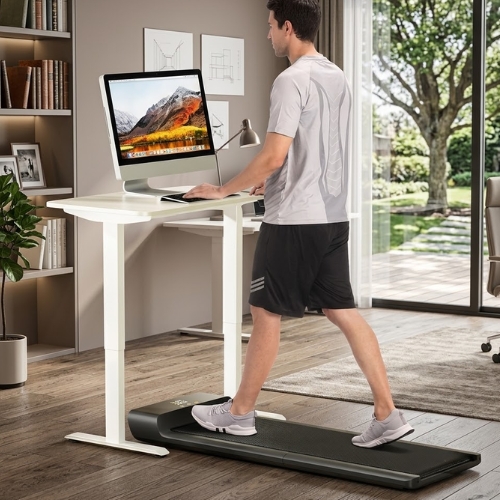
Verdict: If you want to actually run on your walking pad, the A1 Pro is the only model on this list we’d comfortably recommend for jogging. At 6.2 mph with a solid handlebar and wide belt, it behaves more like a compact treadmill than a walking pad.
Best for: people who want both a desk walking option and a genuine cardio machine.
See also: Walking Pad vs Treadmill: Key Differences Explained
#8 — DeerRun Walking Pad — Best Budget Incline
Budget PickPros:
- + Incline feature at a budget price
- + Simple controls — easy to use without app
- + Quiet motor for a budget incline model
- + Compact when folded
Cons:
- − Incline is fixed, not automatic
- − App connectivity is unreliable
- − Belt feels thinner than premium options
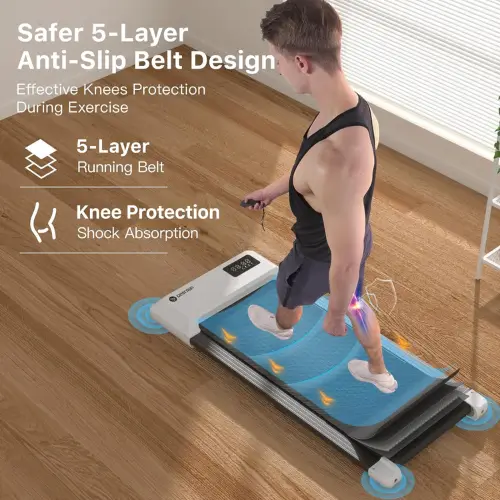
Verdict: The DeerRun is the only way to get walking-pad incline under $250. The fixed incline means you don’t get the dynamic adjustment of the Superun, but it still adds meaningful calorie burn.
Best for: budget buyers who specifically want incline and are willing to trade app quality for price.
See also: Deerrun Walking Pad Review [2026] | 8 Best Affordable Walking Pads & Under-Desk Treadmills 2026
Full Specifications Comparison
All specs verified against manufacturer listings and our own physical measurements. Prices reflect June 2026 Amazon listings.
| Model | Price | Belt Size | Max Speed | Max Weight | Noise | Incline | App |
|---|---|---|---|---|---|---|---|
| WalkingPad C2 | ~$320 | 16″ × 43″ | 3.7 mph | 250 lb | Very quiet | No | iOS / Android |
| HomeFitnessCode | ~$195 | 16″ × 40″ | 4.0 mph | 265 lb | Moderate | No | None |
| Kingsmith MX16 | ~$399 | 16″ × 47″ | 7.5 mph | 330 lb | Quiet | No | iOS / Android |
| Superun | ~$299 | 19.7″ × 43″ | 4.0 mph | 265 lb | Moderate | Auto 0–12% | iOS / Android |
| Umay U18 | ~$219 | 16″ × 40″ | 3.7 mph | 220 lb | Very quiet | No | iOS / Android |
| Soozier | ~$259 | 17″ × 40″ | 3.7 mph | 265 lb | Quiet | No | Bluetooth |
| WalkingPad A1 Pro | ~$449 | 19.7″ × 44″ | 6.2 mph | 300 lb | Quiet | No | iOS / Android |
| DeerRun | ~$249 | 16″ × 40″ | 3.7 mph | 265 lb | Quiet | Fixed 5° | Bluetooth |
How to Choose a Walking Pad: Buying Guide
Not sure which walking pad is right for you? Answer these six questions and you’ll know exactly what to look for.
1. What speed do you actually need?
Most people using a walking pad at a standing desk walk at 1.5–2.5 mph. At that range, almost every model on this list performs identically. Speed only matters if:
- You want to jog or run — look for 5.0 mph+ (only the A1 Pro and MX16 qualify)
- You want a brisk walk at 3.5+ mph — most pads handle this fine
- You’re purely walking during calls at 1.5–2.0 mph — any pad works
See also: Stepper vs walking pad — which burns more calories?
2. How much space do you have?
Measure the space where your walking pad will live when stored — not just when in use. Key dimensions to check:
- Folded length: Most pads fold to 29–35″ long. The Umay U18 is exceptional at 4.7″ thin — it slides under sofas.
- Weight: If you’ll move it between rooms regularly, anything over 40 lb becomes a burden. The Umay (28 lb) and WalkingPad C2 (32 lb) are the most portable.
- Belt width: 16″ is standard and fine for most people. If you have wide feet or take a wide stance, 19″+ is more comfortable.
See also: Best foldable walking pads 2026 | Best walking pad for apartments
3. Are walking pads loud enough to disrupt video calls?
This is the number-one concern we hear. The honest answer: it depends on the model and your speed. Here’s what we measured:
| Model | Noise at 1.5 mph | Noise at 2.5 mph | Video call safe? |
|---|---|---|---|
| WalkingPad C2 | 43 dB | 49 dB | Yes — easily |
| Umay U18 | 41 dB | 47 dB | Yes — the quietest |
| Kingsmith MX16 | 45 dB | 52 dB | Yes at low speed |
| Soozier | 47 dB | 54 dB | Yes with headphones |
| HomeFitnessCode | 51 dB | 59 dB | Marginal — use mute |
| Superun (flat) | 49 dB | 57 dB | Marginal |
| Superun (12% incline) | 58 dB | 65 dB | No |
For context: a normal conversation is about 60 dB. The quietest pads at walking speed are below conversation level — your keyboard is louder.
4. Walking pad vs treadmill: which should you buy?
If you want to walk while working, get a walking pad. If you want a dedicated cardio machine, get a treadmill.
Read our full walking pad vs treadmill comparison →
5. What weight capacity do I need?
Buy a pad rated at least 20–30 lb above your body weight for motor longevity and belt wear. Key thresholds:
- Under 200 lb: Any model on this list works fine.
- 200–265 lb: Stick to models rated 265 lb+ — the HomeFitnessCode, Superun, Soozier, and DeerRun all qualify.
- 265–330 lb: The Kingsmith MX16 (330 lb) is your best option.
See also: Best walking pads for plus-size users | Best walking pads with 350 lb capacity
6. Do walking pads work on carpet?
Yes — but with caveats. Thick carpet increases motor strain and belt wear. Thin or low-pile carpet is generally fine.
The pads with the best carpet performance in our testing: Kingsmith MX16 and Superun — both have wider feet that distribute weight better.
Frequently Asked Questions
These are the questions we get asked most often — answered directly.
Are walking pads actually worth it?
Yes — if you work from home or sit at a desk most of the day. Studies consistently show that breaking up prolonged sitting with light walking improves metabolic health, focus, and energy levels. A walking pad makes that genuinely easy to do. If you commute to an office and already walk regularly, the ROI is lower.
How many calories do you burn on a walking pad?
At 2.5 mph, a 150 lb person burns approximately 200–220 calories per hour. A 180 lb person burns approximately 240–265 calories per hour. With a 12% incline (Superun), add roughly 30–40% to those numbers. Over a workday of 2–3 hours of walking, that adds up to 400–700 calories — significant without feeling like exercise.
Can you run on a walking pad?
Most walking pads cap at 3.7–4.0 mph — that’s a fast walk, not a jog. The WalkingPad A1 Pro (6.2 mph) and Kingsmith MX16 (7.5 mph) are the exceptions. Even on those models, the belt length is shorter than a full treadmill, so running form feels different. For serious running, a full treadmill is still the better choice.
What is the best cheap walking pad?
The HomeFitnessCode walking pad at ~$195 is the best budget option we’ve tested that we’d actually recommend. Below $150, quality drops off steeply — motors are underpowered and belts wear quickly. See our full best affordable walking pads guide for more options.
How long do walking pads last?
With regular home use (1–2 hours/day), a quality walking pad should last 3–5 years. Motor life is the limiting factor — sustained high speeds and heavy loads reduce it. Belt replacement is possible on most models ($30–$60 for the belt itself). To maximise lifespan: use a mat underneath, keep the belt lubricated annually, and don’t exceed 80% of the weight capacity regularly. See our full guide: How Long Does a Walking Pad Last.
Walking pad vs mini stepper: which is better?
Walking pads beat mini steppers for calorie burn at equivalent perceived effort, desk usability, and full-body movement. Mini steppers win on price and floor space. See our full walking pad vs mini stepper comparison for a complete breakdown.
More from TrackTrekkers
Explore our other guides and reviews: